


Operating a modern water or desalination plant is demanding. Operators and maintenance teams must keep the plant producing the required amount of water, maintain equipment.
From Wastewater to 98.7% water Recovery: What a Mountain Lake Pilot Shows About the Limits of Reverse Osmosis
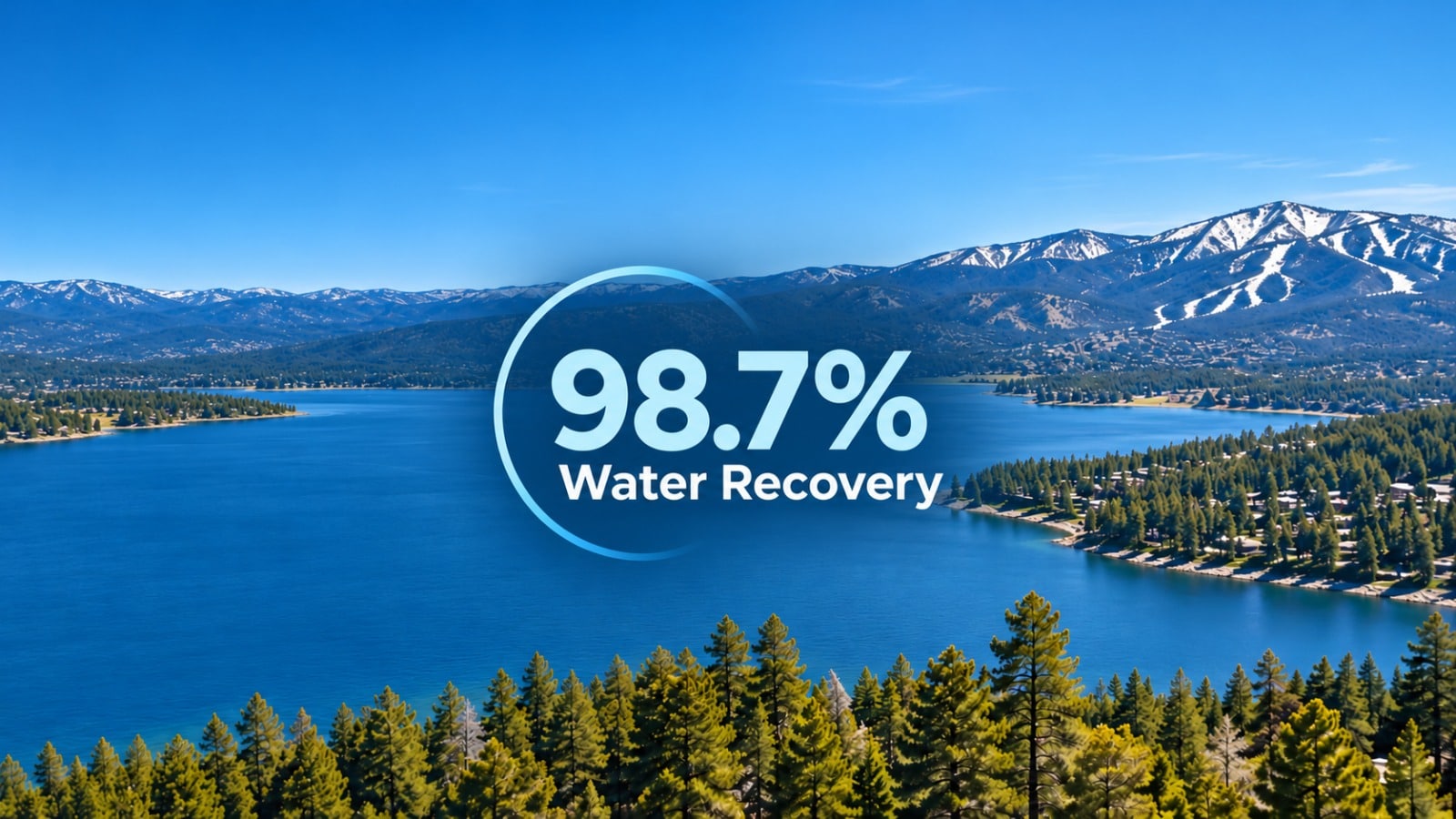
At Big Bear Lake, California, a demonstration project combining Pulse Flow RO (PFRO) with the MaxH2O Desalter recovered nearly all the water from treated effluent, leaving minimal residual brine for disposal.
Every water reuse project faces a limit, often set by the brine composition rather than the membranes themselves. As reverse osmosis recovery is pushed higher, salts and other contaminants become increasingly concentrated, allowing scaling and fouling to take hold.
At Big Bear Lake, California, a demonstration project was pushed toward this limit and successfully met its target of turning 90% of challenging wastewater effluent into reusable water. It went a step further, reaching 98.7% while keeping the system running stably and producing water suitable for snowmaking and irrigation.
Here’s what made it possible, and why this matters for communities with limited options for disposing of their brine.
A resort community with a water problem
Big Bear Valley is a popular year-round resort in California’s San Bernardino Mountains. Like much of California, it has faced drought and declining lake levels. In response, the local water agency developed the Replenish Program, which aims to help restore Big Bear Lake’s water levels and create a reliable new water source: a supply of recycled water for snowmaking, landscape irrigation, and groundwater recharge.
For the local wastewater treatment plant, that meant producing water clean enough for unrestricted reuse and discharge into a lake that is essential to the community’s economy and identity. That set a high bar. Treatment had to meet strict discharge and reuse water quality standards while producing as little brine as possible. After all, recovering more water is only one part of the equation; every cubic meter of remaining concentrated brine needs somewhere to go.
With that in mind, the project team set four goals for the membrane treatment stage:
- Achieve at least 90% water recovery from treated wastewater.
- Minimize brine volume to reduce disposal needs and environmental impact.
- Demonstrate stable, long-term operation with minimal operator intervention.
- Reduce reliance on evaporation ponds, which require extensive land space and are costly to operate.
Why this effluent is hard to treat
The system was fed with wastewater effluent, a challenging starting point for a high-recovery RO process. Key feedwater quality parameters included the following:
- TOC: 8.0 mg/L, above typical RO design guidelines
- Silica: 25.7 mg/L
- Calcium: 62 mg/L
- Sulfate: 140 mg/L
- TDS: 617 mg/L
This combination creates three major obstacles on the system’s path toward achieving high recovery:
- Fouling in the final membrane elements. In conventional RO systems, crossflow velocity decreases toward the tail end of the membrane train. With less shear force to sweep the membrane surface, particles and organic matter can settle on the last membranes in the line.
- Biofouling. Steady operating conditions can drive biofilm growth and attachment. The high organic loading adds to the problem, supporting biological growth on the membranes.
- Scaling. As permeate water is recovered, sparingly soluble salts such as calcium carbonate, calcium phosphate, and silica can exceed their solubility limits and precipitate on the membrane surface.
All three problems become harder to manage as recovery increases. At 95% recovery, the concentration factor reaches 20. That means an extra 5 ppm of silica in the feed translates into an additional 100 ppm in the brine. In conventional RO systems, this issue is addressed by increasing antiscalant doses, applying cleaning procedures more frequently, or settling for lower recovery. Furthermore, none of these measures solve the underlying problem when the brine has nowhere to go.
Two technologies, two jobs
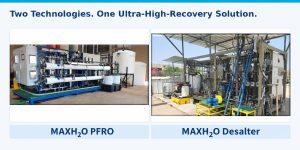
IDE’s approach doesn’t depend on one technology doing everything. The key is combining two technologies: PFRO (Pulse-Flow-Reverse-Osmosis) and the Desalter. The brine leaving the PFRO still contains water that can be recovered by the MaxH2O Desalter, which integrates a fluidized bed reactor (FBR) with the RO process, thus overcoming the scaling limits of the PFRO brine.
In the first stage, the PFRO runs in cycles instead of a steady state. It alternates between production mode and flushing mode. Flushing creates high shear across the membrane surface, which removes deposits before they establish into scale or develop into a biofilm. These continually changing conditions help prevent biofouling. The regular hydraulic flush replaces a major part of the chemical cleaning required in conventional systems.
The PFRO brine still holds valuable water, and the MaxH2O Desalter recovers it in the second stage. The Desalter combines high-recovery RO with an integrated fluidized bed reactor (FBR) in a semi-batch process. As the brine becomes more concentrated, sparingly soluble salts such as calcium sulfate, calcium carbonate, and silica precipitate in the FBR reactor instead of building up on the membrane. The effluent stream from the FBR that returns to the RO has a low scaling potential, enabling the membranes to run at high recovery without losing service life. The Desalter is also designed to manage changes in feedwater quality, an important feature when the feed is the brine from the previous treatment stage.
The two stages are complementary. PFRO recovers most of the water while keeping fouling under control. The Desalter then recovers additional water from the remaining concentrated brine, where scaling becomes the bigger challenge. Together, they address both sides of the problem: keeping membranes clean and managing the salts that limit recovery.
What the field demonstration showed
The integrated system was tested at Big Bear Valley, with the performance of each stage evaluated both individually and as part of the combined process.
PFRO performance: The PFRO demonstration unit ran continuously for more than 15 weeks, achieving 86% recovery. It also ran for a six-day period at 90%. During the run, the specific flux dropped by only 10% without the need for any Clean-in-Place (CIP) procedures. Normalized head loss remained stable, meaning fouling was under control. Permeate quality consistently met treatment targets.
Desalter performance: Treating the PFRO brine, the MaxH2O Desalter recovered an additional 86–91% of the water while keeping permeate conductivity stable. Differential pressure remained stable, meaning that scaling was under control. Silica is the most notable result. At the test concentrations, using the PFRO brine as feed to the Desalter, silica could theoretically have exceeded 1,000 mg/L. Yet, the silica in the Desalter brine was kept below 200 mg/L. The Desalter also removed more than 50% of the total organic carbon through coprecipitation, helping to manage the high organic load in the raw water.
Together, the two stages achieved 98.7% overall water recovery. PFRO recovered 86% of the feedwater, and the MaxH2O Desalter recovered approximately 91% of the remaining brine. The recovered water met the quality requirements for unrestricted reuse, including snowmaking and landscape irrigation—two key applications targeted by the Replenish Program.
Wish to learn more about this project? Watch the full webinar here >> https://ide-tech.com/en/resource/98-7-recovery-in-wastewater-treatment-best-global-demo-results/
Why 98.7% Makes a Difference
Increasing from 90% to 98.7% may seem modest, but in terms of brine volume, it makes a substantial difference. At 90% recovery, 10% of the feedwater remains as concentrate. At 98.7%, that drops to just 1.3%. It is roughly one-eighth of the brine volume to dispose of.
For a community that relies on evaporation ponds, a small brine stream can substantially reduce the pond capacity needed. That means less land, lower construction costs, and fewer long-term management obligations.
How the system reached that recovery matters just as much as the number itself. High recovery over a short trial is one thing; sustaining it without heavy chemical dosing or frequent cleaning is another. This demonstration provided encouraging evidence of operational stability: 15 weeks of continuous PFRO operation, three months without cleaning-in-place (CIP), and stable differential pressure in the MaxH2O Desalter. For utilities, this matters because reuse systems need to perform reliably year after year, not just during a trial.
The results should also be viewed in context. This was a demonstration, not a full-scale plant, and questions about scale-up and long-term performance remain. Even so, the project showed that this combination of technologies could achieve ultra-high recovery from challenging wastewater effluent, maintain stable operation over the test period, and produce water that met the requirements for unrestricted reuse.
Conclusion: Making brine management central to the design
The Big Bear project shows the difference when brine management becomes the starting point of the design rather than a problem left for the end. By combining a pulse flow RO stage that manages fouling with a Desalter that removes scale-forming compounds through controlled precipitation, the system achieved a level of recovery that would be difficult to sustain with conventional RO alone on this challenging feed.
The approach could offer a path forward for inland utilities, mountain resorts, and industrial sites facing strict discharge limits or limited brine disposal options. For these communities and businesses, managing the remaining brine can make the difference between a viable reuse project and one that never gets built.
Could ultra-high recovery help address your water reuse or brine management challenge?
Contact IDE’s team to explore the possibilities.

Dr. Avital Dror-Ehre serves as an R&D Manager at IDE Technologies, spearheading research and development initiatives in advanced desalination, industrial water circularity, and high-recovery wastewater treatment. Prior to joining IDE, she founded and led several pioneering cleantech and water-technology startups, including Hydrophilic Processes and Super-Spectra, bridging academic innovation with commercial deployment. Dr. Dror-Ehre earned her PhD from the Hebrew University of Jerusalem, where her research focused on water treatment chemistry, colloidal interactions, and biofouling control


Don’t Miss Out on IDE’s Latest stories
Related posts
-


Digital Twin Development for Advanced and Optimized Water Operation & Maintenance
Read more -

High‑Recovery RO for Semiconductor Wastewater: Why Conventional Systems Fall Short, and What Comes Next
The semiconductor industry is undergoing a profound transformation. The rapid rise of AI, high‑bandwidth memory (HBM), and advanced logic nodes is driving unprecedented.
Read more