


The semiconductor industry is undergoing a profound transformation. The rapid rise of AI, high‑bandwidth memory (HBM), and advanced logic nodes is driving unprecedented.
Digital Twin Development for Advanced and Optimized Operation & Maintenance
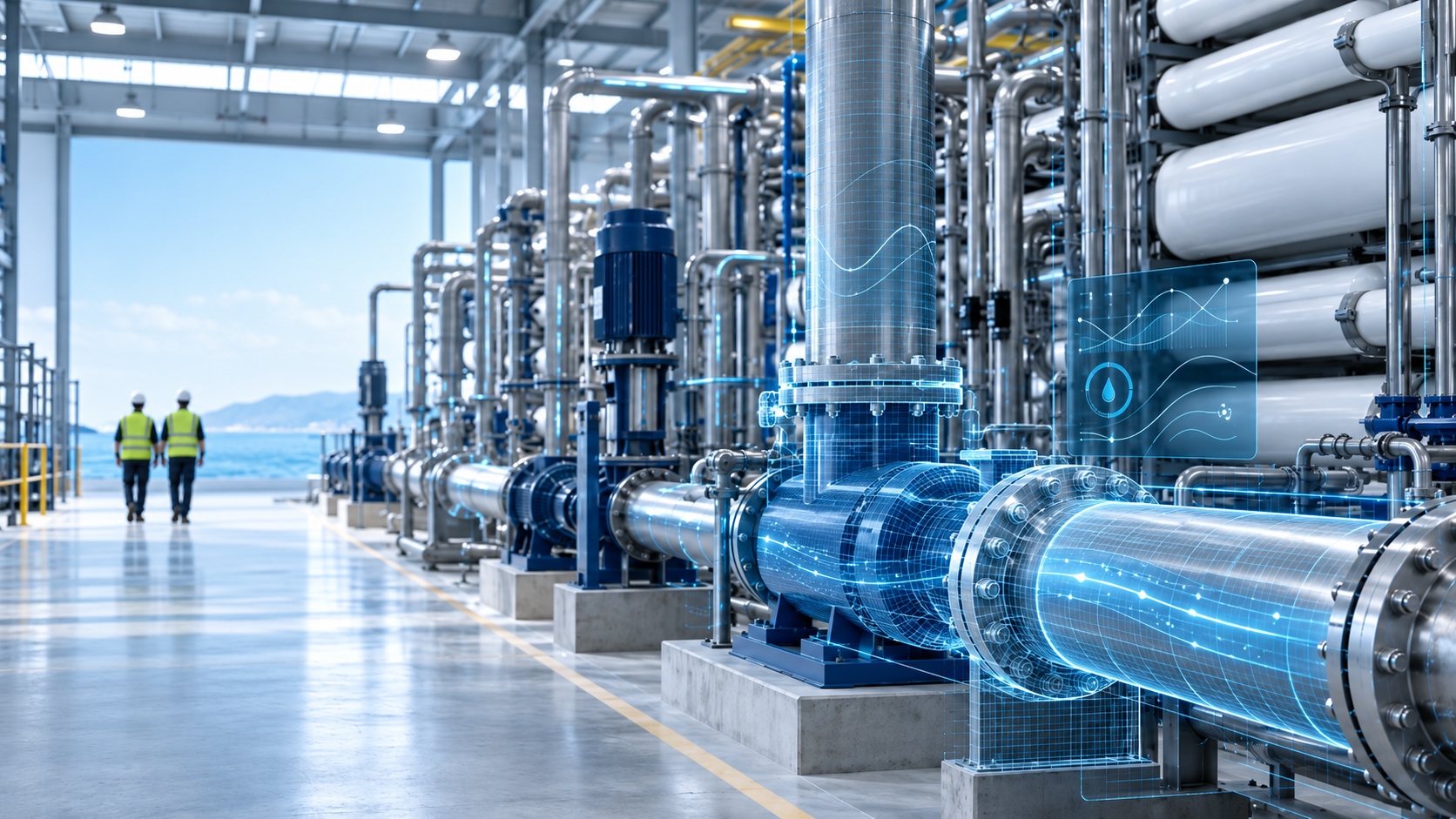
Operating a modern water or desalination plant is demanding. Operators and maintenance teams must keep the plant producing the required amount of water, maintain equipment in good working condition, control energy and chemical consumption, and consistently meet water-quality requirements. For companies operating plants under performance-based contracts, meeting these targets is especially important because operational performance can directly affect costs and financial results.
This is where Digital Twin (DT) technology can make a significant difference.
The idea of using data to make industrial operations smarter is not new. It is part of the broader development commonly known as Industry 4.0. In the water industry, this evolution has led to what is often called “Smart Water”: using plant information to make better operations and maintenance decisions.
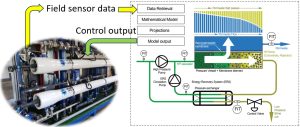
Principle of a Digital Twin
A Digital Twin takes this concept a step further. In simple terms, it is a digital representation of a physical asset or process that uses information from the real plant to understand what is happening, what is likely to happen next, and what actions may improve performance.
However, not everything called a “Digital Twin” is actually a Digital Twin. Some systems simply display plant information. Others use mathematical models to calculate what should be happening and compare those results with actual measurements. More advanced systems can predict future behavior and support, or even influence, operational decisions.
At IDE Technologies, we have been developing Smart Water applications for many years. Drawing on nearly three decades of experience operating large-scale desalination plants, we have developed Digital Twin applications that combine real-time plant data, mathematical models, equipment information, and predictive analytics.
One example began more than a decade ago with a simple idea: calculate how much water a pump should produce and compare that prediction with the amount actually measured by the plant. This type of calculation is sometimes called a soft sensor because it provides information normally obtained from a physical instrument.
The concept was developed further. By combining the Digital Twin with the pump’s control system, the digital model could help determine how the physical pump should operate to achieve the required flow. In other words, the Digital Twin was no longer simply observing the equipment; it became part of the decision-making process.
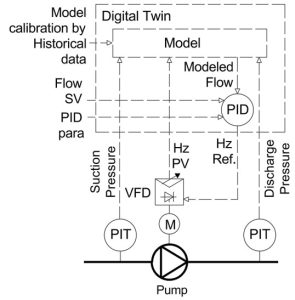 Digital Twin of a Pump controlling required flow without installing physical flowmeters
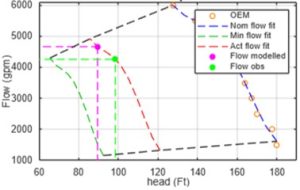
Calibration of the Pump Digital twin based on operational data and OEM pump curves
From monitoring to predicting
The real value of a Digital Twin becomes apparent when it identifies problems before they become failures. Our applications include monitoring seawater intake conditions, optimizing production according to electricity prices, predicting deterioration in rotating equipment, monitoring membrane fouling, and supporting maintenance decisions. These applications can reduce operating costs, improve equipment reliability, extend equipment life, and allow maintenance to be planned based on actual equipment condition rather than a fixed schedule.
Consider reverse-osmosis membranes. Seasonal algae blooms can cause biological material to accumulate on membranes, reducing their performance and shortening their useful life. We developed a Digital Twin that represents how membranes deteriorate over time and how different maintenance strategies can restore performance. This allows operators to evaluate different approaches before deciding when and how to clean or restore the membranes.
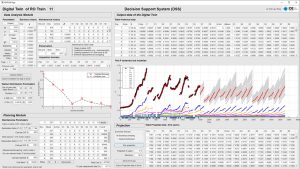
Digital Twin of an SWRO Train, as the engine for a Maintenance Decision Support System
A similar principle applies to pumps.
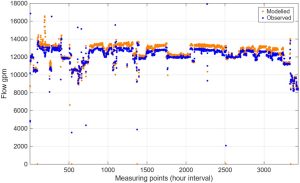
A pump normally has a predictable relationship between its operating conditions and the amount of water it should deliver. Using information from the pump manufacturer and historical plant data, a Digital Twin can estimate the expected performance of a healthy pump.
The predicted performance can then be compared continuously with what the real pump is doing. If the difference gradually increases, it may indicate that the pump is wearing or that another problem is developing.
This provides an important advantage. Maintenance does not necessarily have to be performed simply because a certain number of operating hours has been reached. If the equipment is performing normally, opening it for an overhaul may introduce unnecessary risk and cost. Conversely, if the Digital Twin identifies a developing problem, maintenance can be planned before the problem becomes a major failure.
Projected versus observed flow
Detecting problems through vibration
Vibration provides another example.
All rotating equipment vibrates to some degree. Changes in vibration can provide an early indication that something is changing inside a pump or motor.
Traditional plant monitoring systems often use fixed alarm limits. When the measured vibration exceeds a predetermined value, an alarm is generated. The problem is that normal vibration can change with operating conditions such as pump speed and water flow. A fixed limit may therefore provide very little warning before a serious problem develops.
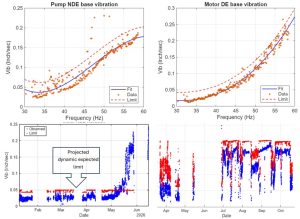 Modeling of dynamic expected vibration limit
A Digital Twin can take a different approach. By learning what healthy vibration looks like under different operating conditions, it can establish a dynamic expected limit. When actual vibration begins to move away from this expected behavior, the system can identify the developing problem much earlier than a conventional alarm.
This changes the role of maintenance from reacting to failures to anticipating them.
Connecting the Digital Twin to the real plant
A Digital Twin is only useful if it can communicate with the physical plant.
Modern Digital Twins can receive information from the plant’s control systems, analyze that information, and return recommendations to operators or, in more advanced applications, commands to the control system.
The technology used to accomplish this may include industrial communication standards such as OPC UA and MQTT. The details of these technologies are important to engineers, but the basic idea is simple: information needs to move reliably between the physical plant, the Digital Twin, and the people or systems making operational decisions.
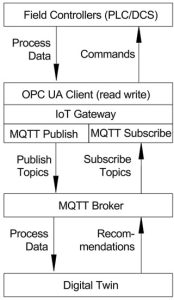 Interface between Field controllers and the al Twin
A Digital Twin is never finished
Perhaps the most important point is that a Digital Twin should not be viewed as a software product that is installed once and then considered complete.
It is an evolving engineering process.
As a plant operates, new information becomes available. Equipment behavior becomes better understood, maintenance teams gain experience, and new failure mechanisms are discovered. That knowledge can be incorporated into the Digital Twin, making its predictions and recommendations progressively more useful.
The ultimate objective is not simply to create a digital copy of a physical plant. It is to create a practical tool that helps people operate the plant better, maintain equipment more effectively, reduce lifecycle costs, and make better decisions about risk.
This also provides a foundation for the next step in Smart Water: AI-enabled operational optimization, where Digital Twins can increasingly use artificial intelligence to learn from plant experience and help identify the best course of action.
The future of plant maintenance is therefore not simply about collecting more data. It is about turning that data into knowledge—and turning knowledge into better decisions.
Contact a water expert today and find out more about how IDE can help you solve your water challenges.

Frits van Rooij, Ph.D. is OT Manager and System Integrator at IDE Technologies, where he has worked since 2001 on industrial automation and control systems for desalination and water treatment facilities. Before joining IDE, he spent five years as Senior Software & Instrumentation Engineer and Division Manager of Industrial Automation at A&B (G. Vassiliou) LTD. He holds a PhD in Maintenance Engineering, Mathematical Modelling and Operational Research from the University of Salford (2018–2022), with a thesis on managing membrane restoration in reverse osmosis desalination using a digital twin, and an MSc in Project Management (2015–2016). He has presented at industry events including AMTA's Membrane NextGen workshop.


Don’t Miss Out on IDE’s Latest stories
Related posts
-


High‑Recovery RO for Semiconductor Wastewater: Why Conventional Systems Fall Short, and What Comes Next
Read more -


ZLD for Steel Plants in India: What Actually Works (and What Fails)
India is in the middle of one of the most ambitious infrastructure expansions in modern history. New airports, railway corridors, expressways, ports, and manufacturing.
Read more


