


Operating a modern water or desalination plant is demanding. Operators and maintenance teams must keep the plant producing the required amount of water, maintain equipment.
Beyond the Myth: The Real Environmental Record of Modern Desalination
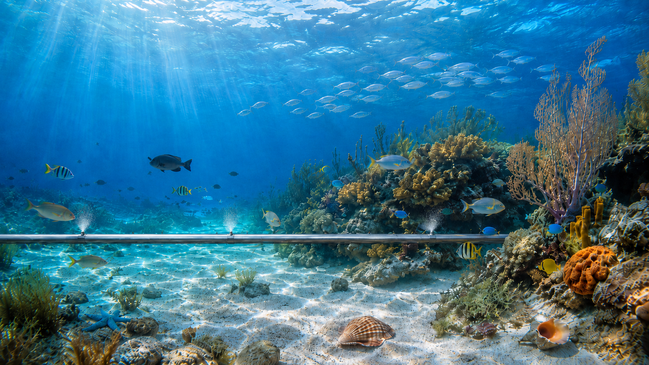
If you live along the Texas coast, chances are you’ve heard the words “toxic brine” and “dead zone” brought up whenever a new desalination plant is proposed. It’s a fair worry to have. The Gulf isn’t just scenery — it’s shrimp boats, oyster reefs, redfish, and a way of life for coastal families, and any project that touches it deserves real scrutiny.
So we looked at what the evidence actually shows: decades of independent ocean monitoring from California, Australia, Israel, Chile, and the Arabian Gulf, alongside IDE’s own record designing and operating some of the most closely watched desalination plants on earth. The picture that emerges is a reassuring one. When desalination is well-designed, carefully sited, and closely regulated, its impact on marine life is minimal, localized, and reversible , while the water security it provides is enormous and lasting.
What created the Fear Around Brine
Brine, the concentrated saltwater left over once seawater has been desalinated, is unavoidable; While the concern around it did not come out of nowhere, it is rooted in the industry’s early days where plants were smaller, monitoring technology was limited, and images of a dense heavy plume spreading across the seafloor made a lasting impression, and it’s easy to see why that image has stuck with people.
But that was decades ago. Desalination today is a mature ‘ tightly regulated infrastructure sector, backed by hundreds of field studies and continuous ocean monitoring. The questions people still ask; will it make the sea too salty, will chemicals build up in marine life, will it damage the seafloor are exactly the right questions. The good news is that we no longer have to answer them with decades-old assumptions, we can answer them with current, verifiable data. The science evolved; public perception just hasn’t caught up yet.
How Modern Plants Actually Discharge Brine
modern large scale seawater reverse osmosis (SWRO)plants use the following four design principles in designing outfall in order to protect the water around them:
- Multi-port diffusers break the plume into many small jets that mix quickly with seawater, rather than settling as one dense mass.
- Careful siting in deep water with strong currents lets denser water disperse instead of pooling. CFD modeling predicts and optimizes exactly how the plume will behave before a single pipe is ever laid.
- Regulated mixing zones require salinity to return to near background levels within a clearly defined distance.
The result is measurable, and it’s reassuring: long-term monitoring consistently shows salinity increases are marginal within the 100 m mixing zone.That’s a small, tightly contained footprint, not the spreading “cloud” of salty water the old imagery suggests
How IDE Engineers Intake and Outfall Systems to Protect the Coast
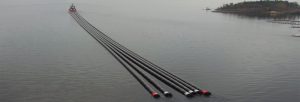
The environmental considerations are decided long before a single drop of water is treated; it comes down to how the intake and discharge pipelines themselves are built.IDE has installed nearly 20 miles of tunneled intake and outfall pipeline worldwide, choosing among four main construction methods depending on the seabed, coastline, and regulatory constraints at each site:
- Pipe jacking (micro-tunneling): a tunnel boring machine launched from an onshore pit excavates beneath the seabed while simultaneously pushing prefabricated pipe into place, with no open trenching or surface disruption. IDE has used it for intake and discharge lines at Sorek, Sorek 2, Eilat, and Western Galilee.
- Segment lining: a larger micro-tunneling technique unrestricted by pipe length or diameter, suited for longer tunnels through harder ground. IDE has applied it on two major desalination projects, including Hadera and Western Galilee.
- Cofferdam and dredging: a temporary dry work enclosure that lets crews excavate near shore without open water intrusion. IDE has executed eight intake pipes across three major projects using this method, including Hadera and Ashkelon.
- Temporary jetty and dredging: for coastlines with high surf or narrow weather windows. At the Aconcagua desalination plant in Chile, IDE used two temporary jetties to keep excavation on schedule despite a short working season.
Once seawater or brine reaches open water, it is dispersed through multi-port diffusers rather than a single outfall pipe, the same design principle, applied consistently from Ashkelon and Hadera to Sorek 2 and Western Galilee, that keeps salinity increases small and localized.
What Really Happens to Marine Life
Ecological studies near outfalls tell an, evidence based story. Some species decline slightly nearby while others (like barnacles or opportunistic invertebrates) actually increase, a pattern similar to natural differences between exposed and sheltered reefs. Many observed effects trace back to hydrodynamics (the physical presence of a structure and its water movement) rather than to salinity itself. Across multiple sites and multiple continents, long-term monitoring has not found persistent biodiversity loss or contaminant buildup attributable to desalination brine under modern operating conditions.
What This Means for Texas Maine Life
The Gulf Coast is one of the most productive marine environments in the country, and any responsible desalination project has to be designed accordingly from day one, not as an afterthought. The good news is that the engineering principles described above are not theoretical. Multi-port diffusion, site-specific current and depth analysis, CFD modeling before a single pipe is laid, and enforced mixing zones have already been tested, monitored, and independently verified on some of the most ecologically sensitive and closely watched coastlines in the world, including the strictly protected California. IDE’s approach starts by modeling, monitoring, and then designing.
Carlsbad, California: Proof on One of the Most Protected Coastlines in the World
The Claude “Bud” Lewis Carlsbad Desalination Plant, designed and operated by IDE Technologies, is one of the most scrutinized desalination facilities in the world, sitting on a highly protected stretch of the Pacific coast. From 2019–2023, independent marine scientists ran an intensive ocean monitoring program under the San Diego Regional Water Quality Control Board, measuring salinity, temperature, chemistry, and biological communities at stations near and far from the outfall as well as at reference sites.
What They found should reassure anyone worried about a similar project near their own coastline: water quality remained healthy, seafloor infauna stayed within reference condition, and trace metals remained at natural background levels. Salinity increases stayed well within California’s strict limit of ≤ 2.0 ppt above ambient at 100 m , the highest reading recorded was 1.45 ppt at 23 m, with ambient levels restored within 200 m of the outfall. Carlsbad shows, in practice that modern SWRO plants can operate safely even on some of the most sensitive coastlines.
Sorek 2: A Closer Look at Brine and Marine Life
IDE’s newest flagship plant, Sorek 2 (Be’er Miriam), shows what these principles look like when they are put into practice at scale.. It is One of the largest SWRO plants in the world at 175 MGD, it sits more than a mile inland from the Mediterranean, so its two seawater intake lines and single brine discharge line had to reach the sea entirely underground. IDE tunneled all 6.5 miles of onshore and offshore pipeline using pipe jacking (the intake lines run a little less than a mile offshore and the brine line about 1.5 miles offshore), discharging through a multi-diffuser system designed to disperse the concentrate quickly rather than let it settle. Because the route was tunneled rather than trenched, the beach and dune habitat above the pipeline needed no permanent excavation; site photos taken after construction show the shoreline at its natural state as no work gas ever been done in the area.
Low environmental impact on marine life ,no seawater chlorination at intake and on-site, low-carbon energy production are among the design choices that earned the plant the 2024 IDRA award for lowest carbon footprint in desalination.
The Environmental price of Not Having Water
When evaluating the environmental footprint of a desalination plant, one must look at the alternatives. Over-pumping has driven the dramatic decline of the rivers, lakes and acquifers threatening supplies for tens of millions of people; rapid depletion of groundwater wells compromise a significant share of local agriculture; thus, responsibly managed desalination isn’t a “last resort”, it’s a central pillar of a resilient water portfolio, alongside conservation, reuse, and better watershed management.
What This Means for Policymakers and Planners
The global data point to a few clear lessons for regulators, utilities, and project developers weighing a decision like this:
- Impacts are local and manageable when plants use advanced diffusers, good siting, and strong operational practices.
- Transparent, science-based regulation with public reporting builds public trust and catches unexpected trends early.
- Best practices are transferable: design and monitoring frameworks proven in one region can help new markets, including Texas, avoid the mistakes of the past.
Desalination’s environmental performance is no longer a mystery: the real challenge now is consistent implementation, not uncertainty.
From Fear to Evidence: A confident Path Forward for Texas
The accumulated evidence is clear: with modern engineering and rigorous regulation, seawater desalination can deliver climate-resilient water without compromising ocean health. The real question is not “Is brine too risky?” anymore ,it is, “Can we afford not to use every responsible tool available including desalination to secure our water future?” Grounded in monitoring data rather than outdated fears , brine shouldn’t be seen as the villain of the story. It is a carefully managed byproduct of a technology backed by IDE’s engineering, IDE’s track record, and IDE’s continuous investment in ocean-protective design, that helps communities adapt to a changing climate and build a more reliable water future, for the Gulf and for the generations that will depend on it.
Contact a water expert today and find out more about how IDE can help you solve your water challenges.

Ms. Teuerstein has been with IDE since 2011 and has been leading the IDE Water Assets business as of 2018.
Her previous roles included establishing and Heading the Commercial Department of IDE and General Counsel for the IDE group. Lihy has demonstrated a history of working in the business environments of large infrastructure projects in all conservative and alternative procurement methods and is skilled in negotiating complex agreements with project partners, off-takers, and clients. She broadly understands the water infrastructure market worldwide and project development processes.
Lihy has a combined LL.B in Law and Far East Studies from the Hebrew University in Jerusalem and is a member of the Israel Bar Association. She also has an M.A. in Sociology and Anthropology from Tel Aviv University.


Don’t Miss Out on IDE’s Latest stories
Related posts
-

Digital Twin Development for Advanced and Optimized Water Operation & Maintenance
Read more -


High‑Recovery RO for Semiconductor Wastewater: Why Conventional Systems Fall Short, and What Comes Next
The semiconductor industry is undergoing a profound transformation. The rapid rise of AI, high‑bandwidth memory (HBM), and advanced logic nodes is driving unprecedented.
Read more


