


Operating a modern water or desalination plant is demanding. Operators and maintenance teams must keep the plant producing the required amount of water, maintain equipment.
High‑Recovery RO for Semiconductor Wastewater: Why Conventional Systems Fall Short, and What Comes Next

The semiconductor industry is undergoing a profound transformation. The rapid rise of AI, high‑bandwidth memory (HBM), and advanced logic nodes is driving unprecedented fab expansion worldwide. But behind this growth lies a critical constraint that is quickly becoming a bottleneck: water.
Modern mega‑fabs consume tens of millions of gallons of water per day, while generating increasingly complex wastewater streams. As municipal infrastructure struggles to keep pace, fabs are being pushed to treat and reclaim more water inside the fence, reliably, efficiently, and at much higher recovery rates than before.This is where conventional reverse osmosis (RO) begins to fail, and where Pulse Flow Reverse Osmosis (PFRO) offers a fundamentally different approach.
Water: The Hidden Bottleneck in Semiconductor Growth
A single mega‑fab can consume 50+ million gallons per day, equivalent to the water demand of a mid‑sized city. At the same time:
- Municipal wastewater treatment plants (POTWs) are not designed for the hydraulic and chemical loads of advanced semiconductor effluents.
- Sustainability targets demand higher recovery and lower discharge.
- Shrinking process nodes generate wastewater with higher variability, higher organics, and higher scaling potential.
The result? Water availability and wastewater treatment capacity are now directly linked to fab uptime, expansion timelines, and long‑term growth.
Why Standard RO Breaks Down at High Recovery
Conventional RO systems were never designed to operate reliably under the conditions typical of semiconductor wastewater reuse. When pushed toward higher recovery, they encounter several fundamental barriers:
1. Scaling at High Concentrations
As recovery increases, ionic concentrations rise, leading to supersaturation and salt precipitation on membrane surfaces. Under constant operating conditions, scaling becomes inevitable.
2. Biofouling from Organics
Residual TOC and COD provide nutrients for bacteria. High flux operation accelerates biofilm formation, degrading membrane performance and permeate quality.
3. Low Shear Forces
Reduced brine flow at high recovery lowers shear forces at the membrane surface, further intensifying both scaling and biofouling.
The operational reality is frequent CIP shutdowns, unstable performance, reduced recovery (often ~30%), and rising OPEX, making conventional RO unfeasible for advanced fab wastewater reuse.
Pulse Flow RO: Changing the Rules of High‑Recovery Operation
Pulse Flow Reverse Osmosis (PFRO) takes a different path. Instead of operating at constant conditions, PFRO introduces controlled, cyclic changes in hydraulic and osmotic conditions—using standard RO membranes and equipment.
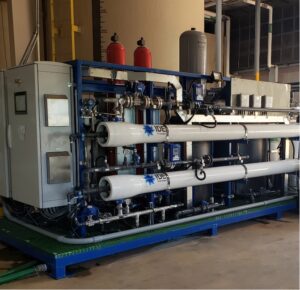
How PFRO Works
PFRO alternates between two modes:
- Production Mode
The brine valve is closed. All feed water is converted to permeate (a “dead‑end” condition), and concentration gradually increases. - Flushing Mode
The brine valve opens briefly, creating very high brine velocity and shear forces that flush away accumulated foulants before scaling or biofilm formation can occur.
These cycles are intentionally shorter than the induction time for crystal formation, preventing from reaching the nucleation phase altogether.
Built‑In Fouling and Scaling Control
PFRO’s cyclic operation addresses the core failure modes of high‑recovery RO:
- Scaling Prevention: Concentrated brine is discharged before crystals can form.
- Biofouling Suppression: Constantly changing conditions force bacteria to spend energy adapting rather than reproducing.
- High Shear Cleaning: Frequent short, intense flushing pulses remove deposits from membrane surfaces.
The result is a system that can operate at significantly higher recovery with stable pressure, stable rejection, and minimal performance degradation.
Cleaning Without Shutdowns: CIO Instead of CIP
Another key advantage of PFRO is its Cleaning‑In‑Operation (CIO) capability.
Unlike conventional RO, which requires periodic shutdowns for manual CIP, PFRO maintains membrane cleanliness online and automatically. This delivers several economic and operational critical benefits:
- Higher system availability (no CIP downtime)
- Reduced maintenance labor
- Lower installed redundancy—and therefore lower CAPEX
- Stable high flow factor and reduced energy consumption – and therefore lower OPEX
Importantly, cleaning solutions are recycled, avoiding a meaningful increase in operating costs.
Real‑World Proof: Semiconductor Fab Case Study
In a semiconductor fab wastewater reuse application, PFRO was installed in parallel with an existing conventional RO system and treated the same challenging feed water.
Key challenges included:
- Feed SDI consistently above membrane guidelines (often >5, up to non‑measurable)
- Highly variable conductivity and organic load
- Conventional RO requiring weekly CIP and operating at ~30% recovery
PFRO performance highlights:
- Stable operation at 50–54% recovery
- Stable feed pressure and normalized head loss—even under extreme SDI
- No CIP shutdowns; first CIP after 1.5 years
- Stable rejection over time, unaffected by cleaning in operation (CIO)
This side‑by‑side comparison clearly demonstrated PFRO’s ability to sustain high recovery where conventional RO could not.
Execution Matters: Modularity and OSM (Off-site Manufacturing)
Technology alone is not enough. In retrofit and greenfield fabs alike, execution risk, footprint constraints, and schedule pressure are major concerns.
PFRO systems are delivered as prefabricated modular units (MPD), enabling:
- Extensive factory testing (FAT) before site installation
- Shorter construction and commissioning schedules
- Reduced site labor and safety risk
- Flexible layouts, even stacked configurations in space‑constrained facilities
- Wide range of capacities (1,000 m3/d – 10,000 m3/d designs) to adapt to client specific requirements in terms of flow and redundancy
This modular, off‑site manufacturing (OSM) approach is critical for deploying advanced water treatment solutions without disrupting fab operations.
On-demand webinar: Discover why OSM, with a plug-and-play assembly, is emerging as a necessary strategy to reduce cost, risk, and construction timelines in your semicon fab: https://ide-tech.com/en/resource/semiconductor-industry-osm-water-treatment-methodology/
Looking Ahead: Toward Minimal and Zero Liquid Discharge
As sustainability targets tighten, the industry is moving beyond high‑recovery RO toward Minimal Liquid Discharge (MLD) and advanced ZLD concepts. Current HRRO technologies in the market reach 90% recovery while IDE’s MaxH2O desalter can reach up to 98% recovery limited by the osmotic pressure. Next generation HRRO design is breaking even the osmotic pressure barrier, reaching recovery above 99% and brine salinity of ~20% by implementation of LSR membranes. The implication is dramatic reduction in the size of thermal ZLD units, decreasing both CAPEX and OPEX of the plant.
Key Takeaway
For advanced semiconductor fabs, water is no longer a utility, it’s a strategic asset. Conventional RO systems cannot meet the combined demands of high recovery, reliability, and uptime. PFRO demonstrates that by rethinking how RO operates, not just how it’s designed, fabs can reclaim more water, reduce risk, and support sustainable growth at scale.

Oren Yogev is a Process Engineer at IDE Technologies, specializing in water treatment and desalination. In his role, he contributes to the design, engineering, and implementation of advanced water treatment systems for municipal and industrial clients, with a focus on practical, innovative solutions that address water scarcity and operational reliability.
Oren brings hands-on experience across wastewater treatment, plant commissioning, WASH infrastructure, and environmental remediation. Before joining IDE, he served as a Process Engineer at Aqwise, where he managed the startup, operation, optimization, and troubleshooting of wastewater treatment plants in Israel, while also supporting commissioning projects in Latin America and Europe. He has also worked as a WASH Expert with IsraAID, conducting field assessments and developing water, sanitation, and hygiene solutions for affected communities, and has experience in soil and groundwater remediation, gray water research, and reclaimed water analysis.

Don’t Miss Out on IDE’s Latest stories
Related posts
-

Digital Twin Development for Advanced and Optimized Water Operation & Maintenance
Read more -


ZLD for Steel Plants in India: What Actually Works (and What Fails)
India is in the middle of one of the most ambitious infrastructure expansions in modern history. New airports, railway corridors, expressways, ports, and manufacturing.
Read more


